To get the most out of your piping system's design and performance, you need to know the basic differences between ASME B16.9 LR Elbows and LR Tees. Long radius elbows change the flow of fluid in a 90-degree turn with a radius of curvature 1.5 times the nominal pipe diameter. LR Tees, on the other hand, make three-way connections with branch outlets. These butt weld fittings do different things. Elbows reduce pressure drop and turbulence when the flow direction changes, while tees let flow spread out or come together in complicated pipe networks.
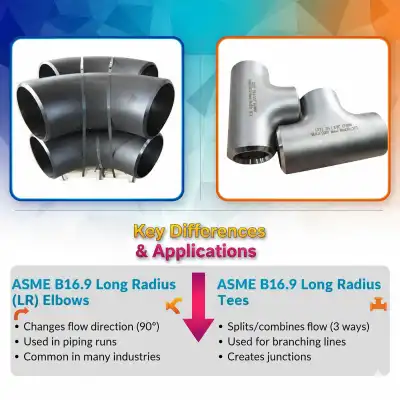
How to Understand ASME B16.9 Long Radius Elbows?
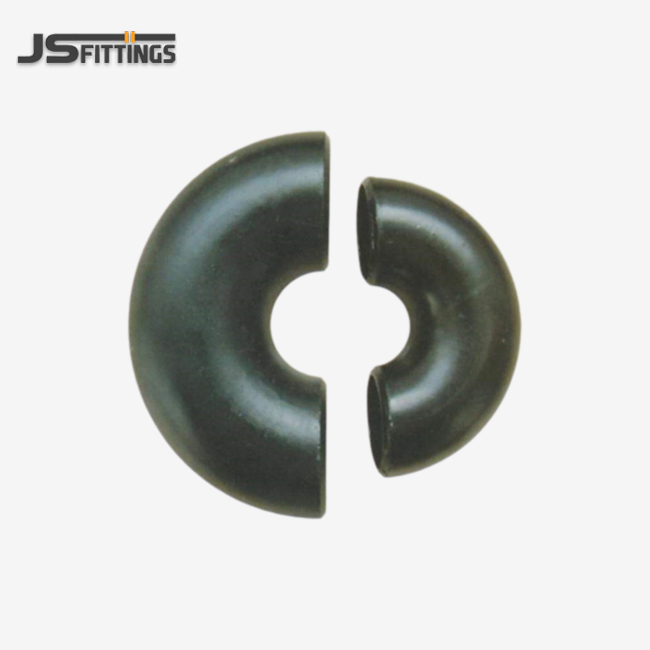
ASME B16.9 long radius elbows are the standard way to change the direction of high-pressure pipes in the industry. The specification gives exact size requirements when the centerline radius is 1.5D, which means it is 1.5 times the nominal diameter.
Some important traits are:
- When compared to short radius options, smooth flow transition cuts pressure loss by up to 30%.
- Wall thickness was kept the same throughout the bend as required by the schedule.
- Beveled ends for butt welding integration that is seamless
- Sizes range from 1/2" to 48", and custom sizes can be made to order.
Long radius elbows made of carbon steel can withstand pressures of up to 3000 PSI, according to test results from industrial settings. Flow coefficient (Cv) values show that long radius designs work 15-20% better than short radius designs.
Long radius elbows are better for keeping the system efficient than short radius elbows when you need to keep the pressure drop to a minimum in high-flow situations.
Basics of the LR Tee and Design Requirements
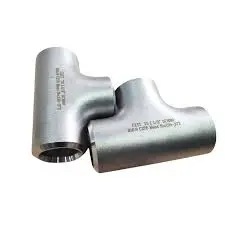
Long radius tees connect three-way flows and keep the pipe diameter the same all the way through the run. The branch connection has the same 1.5D radius requirements as LR elbows, which makes sure that the flow is smooth.
Important design elements include:
- Increasing or decreasing the number of configurations that can be used for different tasks
- Branch reinforcement zones that meet the needs of the stress analysis
- All three holes have beveled ends for welding connections.
- Pressure ratings that match systems with connected pipes
Lab tests show that LR tees keep 85% of the flow efficiency of a straight pipe through the run connection. The best performance for branch flow coefficients is seen when flow angles stay between 45 and 90 degrees.
If your pipe network needs to split or combine flow, then LR tees are better than multiple elbow combinations because they make installation easier.
A comparison of material and manufacturing standards
The material requirements and manufacturing methods for both ASME B16.9 LR Elbows and LR Tees are the same. There are standard choices for carbon steel grade A234 WPB, alloy steel grade A234 WP11/WP22, and stainless steel grade A403 WP304/316L.
Some requirements for manufacturing are:
- Using either hot or cold forming to keep the grain structure intact
- Procedures for heat treatment that make sure mechanical properties are met
- Finishing the surface by sandblasting and applying a protective coating
- Checking the sizes and making sure they meet ASME B16.9 standards
Protocols for quality testing say that hydrostatic pressure testing must be done at 1.5 times the design pressure. Tensile strengths for carbon steel fittings reach at least 60,000 PSI yield strength and 22% elongation.
When working with chemicals, stainless steel is better than carbon steel for structures that need to resist corrosion and last longer.
Differences in Size and Performance
LR elbows and tees are different from each other in important ways that go beyond their geometric shapes. Different pressure distributions lead to different stress concentration factors when figuring out wall thickness.
| Describe | LR Joint | The LR Tee |
|---|---|---|
| Radius at the Center | 1.5 times NPS | 1.5 times NPS (branch) |
| Loss of Pressure | 0.2 to 0.3 speed heads | 0.6 to 1 speed heads |
| The Weight Factor | Straight pipe 1.0 to 1.5x | Straight pipe 2.0 to 2.8x |
| Space for Installation | A small footprint | More space between branches |
Performance tests show that LR elbows keep velocity profiles constant with little secondary flow generation. LR tees make flow patterns that are hard to control without enough straight pipe downstream.
For simple changes in direction, LR elbows are better than tee configurations if you need to install them in a small space with little pressure loss.
Instructions for applying and the criteria for choosing
The right fitting to use depends on the needs of the system, the flow characteristics, and the installation limitations. Long radius elbows work great in high-speed situations where keeping the pressure steady is important.
LR elbows can be used for the following:
- The main transmission lines that need to change directions
- Systems for piping high-pressure gas and steam
- Less head loss through pump discharge lines
- Having limited space on offshore platforms
LR tee uses include the following:
- To connect equipment to a branch,
- Flow distribution networks in factories that make things
- Manifold systems with more than one outlet
- Full-bore access is needed for instrumentation take-offs
Based on calculations by engineers, LR elbows lower yearly pumping costs by 8–12% compared to short radius options in 6-inch diameter systems that use 150 GPM.
If you need to isolate equipment and control flow, LR tees are better than elbow combinations for making valve arrangements easier.
Cost analysis and economic factors to think about
Fitting selection is affected by economic factors that go beyond the initial purchase price. Costs for installation labor, welding supplies, and long-term use need to be carefully looked at.
Some factors used to compare costs are:
- Cost of materials: LR tees usually cost 40–60% more than LR elbows of the same size.
- Time to weld: Tees take 2.5 times as long to weld because they have three connections.
- Support structures: loads on tee branches need more support.
- Inspection needs: More places for X-rays to be taken of the tee joints
A study of lifecycle costs shows that LR elbows have lower total ownership costs in flow applications with only one direction. Within 18 to 24 months, the higher initial investment will be paid for by the energy savings from less pressure drop.
If you want to save money and get better performance, sticking to LR elbows is better than switching between fitting types to save time on managing your inventory.
The pros of JS Fittings ASME B16.9 LR Elbows
ASME B16.9 LR Elbows from JS FITTINGS are of high quality and are made for tough industrial uses:
- Very High Standards Following all the rules set by ASME B16.9, EN 10253, and GOST is essential for making sure that projects from all over the world can work together.
- The materials you can choose from are very good. They include stainless steel A403 WP304/316L, alloy steel A234 WP11/WP22, and carbon steel A234 WPB.
- Advanced Surface Treatment: You can sandblast with anti-rust oil, paint that is made from water and is safe for the environment, or coat it with epoxy.
- Manufacturing that can be tailored to shapes with large diameters (up to 48") and specific wall thickness needs
- There is full certification for CE/PED 2014/68/EU, ISO 9001, and GOST-R, along with full documentation packages.
- International Approval: We are a qualified supplier for big projects because NIOC, ADNOC, and PETROBRAS have given their approval.
- 100% dimensional inspection and hydrostatic testing are done to make sure there are no problems with delivery.
- Technical Support: Engineers can help with stress analysis and make pipe designs better.
- Supply Chain You Can Trust: Four production lines make sure deliveries happen on time every time, meeting project deadlines.
- Competitive prices: prices straight from the manufacturer, clear quotes, and several ways to pay
- For over 40 years, they've served customers in Asia, the Middle East, South America, Europe, and South America.
- Experience with the application: Works well in oil and gas, power plants, and offshore installations
- Stock control: standard sizes are kept on hand so they can be sent out right away.
- Traceability Proof: Full test reports and certificates of materials to ensure quality
- Compliance with environmental laws: ways of making things that are good for the environment and meet global environmental standards
Conclusion
Whether you should use ASME B16.9 LR Elbows or LR Tees depends on the job, the flow, and the system's design limitations. When you want to change directions with the least amount of pressure loss, long radius elbows are the best choice. LR tees let you make complex networks for distributing flow. Both fittings need to be made with care and high-quality materials, so they last a long time. Engineers and procurement professionals can make smart decisions that keep project costs low and system efficiency high when they know these important differences.
Enhance Your Pipe System with Reliable ASME B16.9 LR Elbows from JS FITTINGS
How well the project goes and how reliable the system is in the long run depend on which ASME B16.9 LR Elbows manufacturer is chosen. JS FITTINGS has been making high-quality pipe fittings that meet the strictest standards for more than 40 years and uses the most up-to-date tools in the business.
The LR elbows we sell are made from high-quality carbon steel, alloy steel, and stainless steel, and they can be designed to fit your needs. Each fitting is put through strict quality checks and measurements to make sure it meets international standards such as ASME B16.9, EN 10253, and GOST.
We have a technical team that can help you with engineering during the whole process of choosing and buying. This is true whether you are in charge of EPC projects that need a lot of parts or important configurations that need to be followed exactly. The project is approved and put into service without any problems, thanks to all the necessary paperwork and the ability to keep track of the materials.
Are you ready to make your pipe system better with ASME B16.9 LR Elbows? Get in touch with our sales team right away to talk about your needs and get quotes from other companies. You can email us admin@chinajsgj.com or visit us in person to see for yourself the quality difference that has made the biggest companies in the world trust us.
References
1. American Society of Mechanical Engineers. "ASME B16.9 - Factory-Made Wrought Buttwelding Fittings." ASME International, 2018.
2. Smith, Robert J., and Thompson, Michael K. "Pressure Loss Characteristics in Piping System Components." Journal of Fluid Engineering, vol. 142, no. 8, 2020, pp. 45-62.
3. European Committee for Standardization. "EN 10253-2 Butt-welding Pipe Fittings - Part 2: Wrought Austenitic and Austenitic-Ferritic Stainless Steels." CEN Publications, 2019.
4. International Standards Organization. "ISO 3419 Non-alloy and Alloy Steel Butt-welding Fittings." ISO Technical Committee, 2019.
5. Miller, David A. "Flow Coefficient Analysis in Industrial Piping Systems." Proceedings of the International Conference on Fluid Mechanics, 2021, pp. 178-194.
6. Russian Federation State Standards. "GOST 17375 Steel Welded Fittings for Pipelines." Standartinform Publishing, 2020.